
Is Building A CRM Worth It For Your Business Growth
Many businesses reach a point where spreadsheets stop working. Leads increase, follow-ups get missed, and data becomes hard to manage. This is where CRM tools come in. But the real question is not whether you need a CRM. It is whether you should build your own or use an existing one.
What Does Building a CRM Mean
Building a CRM means creating a system tailored to your workflow. It includes lead tracking, communication, reporting, and automation based on your needs.
For some sectors, such as schools, a CRM for Education can be built to align with admission cycles, student data, and inquiry tracking.
When Building a CRM Makes Sense
Custom CRM works best in specific cases.
You have unique workflows
If your process does not fit standard tools, a custom CRM helps.
You need full control
You can decide on features, data structure, and integrations.
You plan long-term scaling
A tailored system grows with your business.
You operate in niche industries
For example, a CRM For Education can handle admissions, counselling, and the student lifecycle better than generic tools.
When You Should Not Build a CRM
Most businesses do not need to build from scratch.
You want quick results
Custom CRM takes months to develop.
You have a limited budget
Development and maintenance costs add up.
Your team is small
Simple tools can handle your needs.
You lack technical support
Without a tech team, managing a CRM becomes difficult.
Custom CRM vs Ready CRM Tools
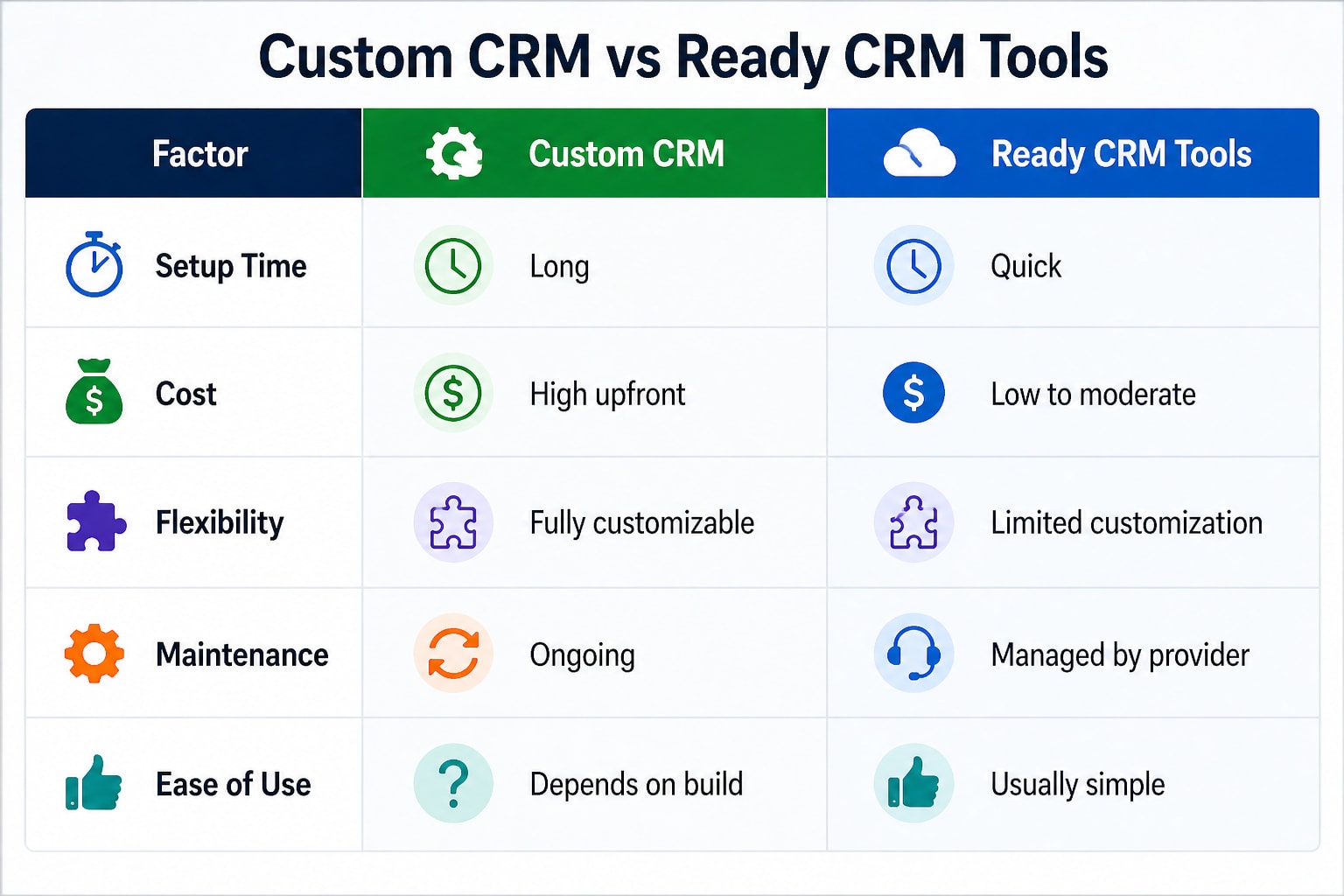
Factor | Custom CRM | Ready CRM Tools |
|---|---|---|
Setup Time | Long | Quick |
Cost | High upfront | Low to moderate |
Flexibility | Fully customizable | Limited customization |
Maintenance | Ongoing | Managed by provider |
Ease of Use | Depends on build | Usually simple |
Real Use Case: CRM For Education
Schools and institutes often consider building their own systems. But many start with ready tools and later customize.
A CRM for Education helps in:
Managing student inquiries easily
Tracking admission stages clearly
Automating follow-ups
Storing student records in one place
Improving conversion from inquiry to enrollment
Building one makes sense only when standard tools fail to match workflows.
Cost of Building a CRM
Here is a simple breakdown:
Development cost depends on features
Ongoing maintenance is required
Updates and bug fixes need resources
Hosting and security add extra cost
For most businesses, this becomes a long-term investment rather than a quick solution.
Better Approach for Most Businesses
Start with a ready CRM. Understand your process. Then decide if you need custom features. Many tools already offer flexibility for industries like education. A good CRM for Education can cover most needs without building from scratch.
Final Thoughts
Building a CRM is not always the right move. It works for businesses with complex workflows and strong technical support. For others, using a ready tool saves time, cost, and effort.
Frequently Asked Questions
Is building a CRM better than buying one
It depends on your needs. Custom CRM offers flexibility, but ready tools are faster and easier to use.
How long does it take to build a CRM
It can take a few months depending on features and complexity.
What is the biggest challenge in building a CRM
Ongoing maintenance and updates are the biggest challenges after development.
Can small businesses build their own CRM
Most small businesses should avoid building and use existing tools instead.
Is CRM for education different from normal CRM
Yes. It focuses on student lifecycle, admissions, and inquiry tracking.
Related Posts
Easiest To Use CRMs For Schools And Admissions Teams
Find the easiest CRM for Education tools for schools and admissions teams. Compare features, usability, and benefits to simplify lead tracking and enrollment.
Can Private Schools Benefit From A CRM System
Can private schools benefit from a CRM system? Learn how CRM helps manage admissions, follow ups, and student data to improve efficiency and growth.